I may just be the only reader of this blog in the NY area, but I believe this is worth mentioning anyhow. Richard Dawkins will be giving a talk bright and early this saturday morning, and you can apparently RSVP in the comments section of this post to get put on the list to attend.
There's probably a catch, but I'd say it's worth a shot.
Update: Full! My new plan is to crowd around the entrance and scream like a teenage KISS fan the second I see someone I've seen a picture of before. They'll be forced to let me in.
Wednesday, April 30, 2008

Tuesday, April 29, 2008
Beautiful Robots
AirJelly:
AquaJelly:
Those are via Engadget.
Also there's the AirRay:
I got to see the AirRay as well as a couple pneumatic water-dwelling robots on display at the Design and the Elastic Mind exhibit at the MoMa on Sunday. I'll be posting some details of all I saw there here or on the other blog before too long. So neat!
OH! And this is a natural place to link Theo Jansen's Strandbeasts, kinetic sculptures that Jansen speaks of as living beings that will roam the beaches.
AquaJelly:
Those are via Engadget.
Also there's the AirRay:
I got to see the AirRay as well as a couple pneumatic water-dwelling robots on display at the Design and the Elastic Mind exhibit at the MoMa on Sunday. I'll be posting some details of all I saw there here or on the other blog before too long. So neat!
OH! And this is a natural place to link Theo Jansen's Strandbeasts, kinetic sculptures that Jansen speaks of as living beings that will roam the beaches.
The View From Heaven
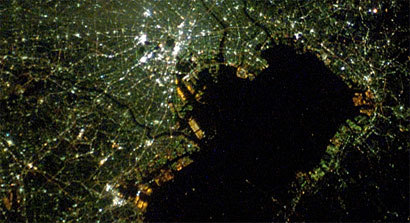
The Earth Observatory site has an article about nighttime shots of various cities around the world taken from the ISS, as well as some thoughtful commentary on certain features and trends that can be found in the images. They also link to a 126mb quicktime video tour that I highly recommend pulling down and watching.
A while back an astronaut put together a barn door tracker out of spare parts that allowed him to take long-exposure shots and keep the target in the center of the frame while the ISS hurdled through space above it. It's really spare parts, too--he's using an electric drill to turn the knobs!
The picture above is of Tokyo. Its bluish-green color, they say, is indicative of all Japan for their use of mercury vapor lighting. Something else I found interesting (hand-picking from a great many interesting things here) was that some cities bear a striking resemblance to other nasa images, particularly of nebulae found way on the other side of the ISS.
Via Kottke.
Monday, April 28, 2008
Science in Art: H2O


Paintings by an anonymous artist with a Ph.D in DNA crystal structures. View more molecules at Art of Chemistry.
Photos for thought. Allometry.

Human and chimpanzee babies share a similar skull shape. As chimpanzees develop certain facial bones grow rapidly compared to others resulting in the characteristic pronounced brows and elongated jaw of an adult chimpanzee. These facial bones grow in humans too, but at a much slower rate. A consequence of this is that our adult skulls look more like the juvenile skulls of both species, but a mature chimpanzee's skull looks pretty different!
Growing different parts of the body at different rates is called allometric growth and it plays a central role in proportioning the adult form. Because a small genetic change can alter relative growth rates significantly, mutations that affect allometric growth can result in very different looking adult forms in closely related species.
 An image of Pinkie, a chimpanzee who lives in a sanctuary for orphaned primates in Tacugama. Her unusual coat of white fur makes this infant picture of her quite striking. Click it to see a larger version.
Saturday, April 26, 2008
Science in Poetry (or Song)
PhaWRONGula is a blog of verse inspired by Pharyngula, a blog of biology and atheist polemic. The poetry is sharp, scientific, progressive and very topical -- funny too. It's a lyric collection that easily connotes a modern day Swift and Twain.
Martin Luther, Christian hero,
Rated all the Jews as zero:
Work them! Out them! Purge the stain!
We're at fault for Jews not slain.
Charlie Darwin fancied finches,
Measured up their beaks in inches,
Gathered gobs of evidence...
OMG! This all makes sense!
Martin Luther gave the stinking
Nazis all his Christian thinking:
When you meet an evil Jew,
Ask: What Would Jehovah Do?
Charlie Darwin, keen observer,
Used his brain, not Christian fervor,
Found that Mother Nature works
By keeping beneficial quirks.
Adolph Hitler used his Bible,
Buoyed by Luther's lurid libel,
To support his sick solution--
Roundup, rail truck, execution.
Christian anti-science kooks
Seem ill at ease with history books.
Rather than accept the shame,
Guess which hero gets the blame?
Read more about the content of this poem at Pharygula: The Great Godwinization.
Martin Luther, Christian hero,
Rated all the Jews as zero:
Work them! Out them! Purge the stain!
We're at fault for Jews not slain.
Charlie Darwin fancied finches,
Measured up their beaks in inches,
Gathered gobs of evidence...
OMG! This all makes sense!
Martin Luther gave the stinking
Nazis all his Christian thinking:
When you meet an evil Jew,
Ask: What Would Jehovah Do?
Charlie Darwin, keen observer,
Used his brain, not Christian fervor,
Found that Mother Nature works
By keeping beneficial quirks.
Adolph Hitler used his Bible,
Buoyed by Luther's lurid libel,
To support his sick solution--
Roundup, rail truck, execution.
Christian anti-science kooks
Seem ill at ease with history books.
Rather than accept the shame,
Guess which hero gets the blame?
Read more about the content of this poem at Pharygula: The Great Godwinization.
Subscribe to:
Posts (Atom)
